Calibrating your experience
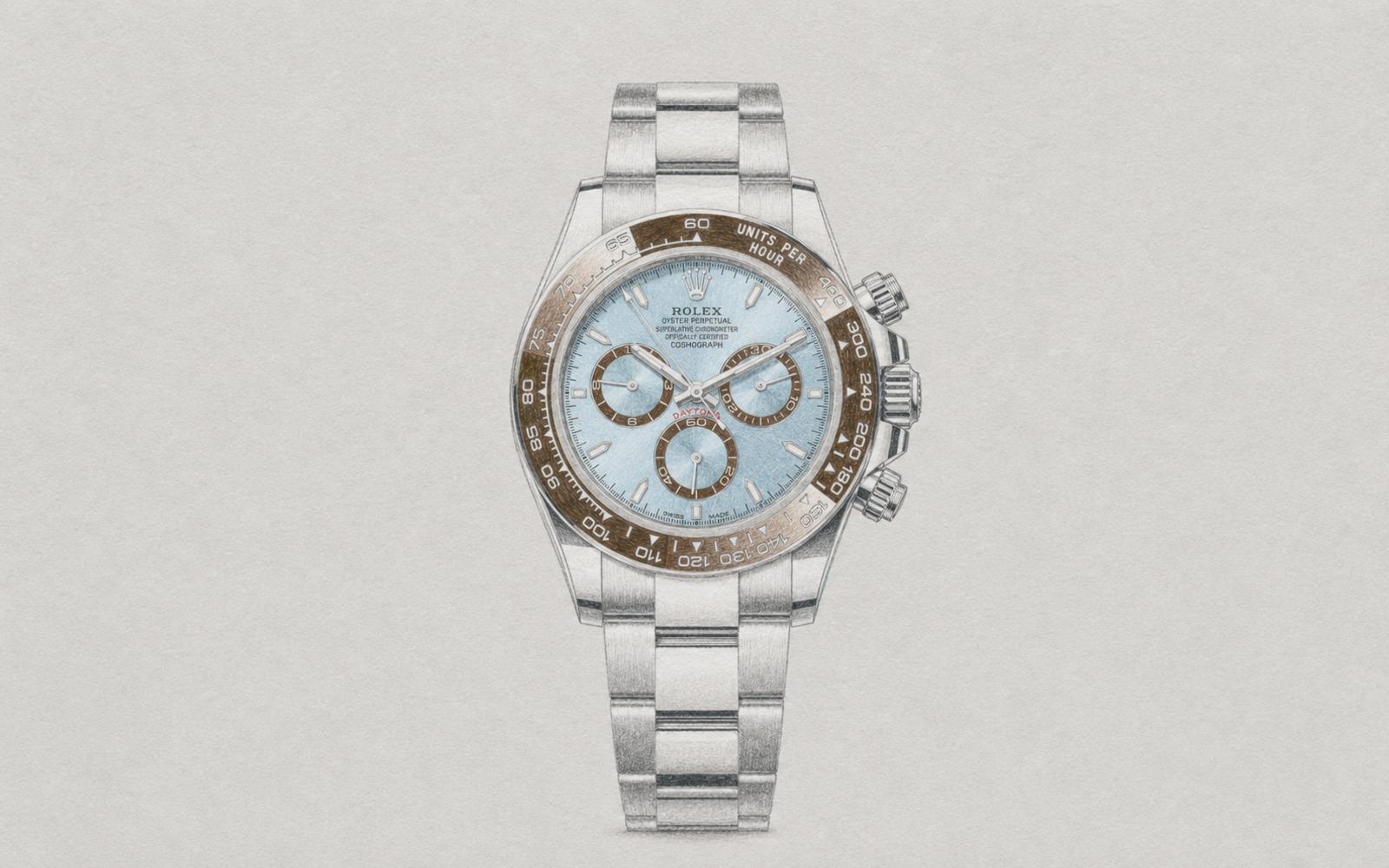
Rolex · Cosmograph Daytona · 1265xx (2023-Current gen) · Platinum
Cosmograph Daytona
Ref: 126506-0001
Platinum Ice Blue Dial
Also known as “Platona”
0 Available
Today’s Market Value
$123,747
(MSRP $84,600)
Editorial Article
The platinum Rolex Cosmograph Daytona is a masterclass in hiding something extremely conspicuous in plain sight. Its silvery case and bracelet can initially resemble white gold or even steel, but the illusion ends the moment the watch reaches the wrist. Constructed from dense 950 platinum, the Daytona has a physical gravity unlike any other version of the model. Rolex balances that serious mass with an ice-blue dial and chestnut-brown ceramic bezel, a color combination that has become inseparable from the platinum line. The result is neither a traditional racing watch nor a conventional dress chronograph, but a peculiar and compelling mixture of motorsport history, modern engineering and almost comically discreet extravagance. The Daytona began in 1963 with a far more practical assignment. Rolex created the Cosmograph for professional racing drivers, placing its tachymetric scale on the bezel so average speed could be calculated over a measured distance. The early watches were manually wound, comparatively compact and initially less celebrated than the brand’s diving and travel watches. Their fortunes changed as motorsport associations deepened and collectors developed an appreciation for exotic dials, screw-down pushers and the model’s disciplined three-counter layout. Paul Newman supplied the most famous human connection, but the Daytona’s lasting strength came from Rolex’s refusal to abandon its recognizable architecture even as the watch evolved from trackside instrument to cultural icon. Precious metal entered the story long before platinum. Yellow-gold Daytonas appeared during the manually wound era, and extraordinarily rare diamond-set references such as the 6269 and 6270 demonstrated that Rolex was willing to turn its utilitarian chronograph into high jewelry. Automatic winding arrived in 1988 with the Zenith-derived calibre 4030 generation, followed in 2000 by the fully manufacture-developed calibre 4130. By then, the Daytona had become established in steel and several shades of gold, yet one material remained conspicuously absent. Platinum—difficult to machine, unusually heavy and traditionally reserved for Rolex’s most elevated watches—would not reach the Daytona until the model’s fiftieth year. When reference 116506 appeared in 2013, it became the first production Daytona made in platinum. Rolex never formally described it as a limited anniversary edition, but its arrival exactly fifty years after the original Cosmograph made the connection impossible to ignore. More surprising than the metal was the color scheme. An ice-blue dial was surrounded by a monobloc Cerachrom bezel in chestnut brown, creating an unexpectedly warm frame around the cold tone of the platinum. Matching brown rings encircled the chronograph counters, while the full platinum Oyster bracelet ensured that the watch’s enormous substance was experienced rather than merely observed. It was a Daytona that looked calm in photographs and felt almost absurdly serious in the hand. The platinum family soon expanded beyond the original luminous-marker dial. Rolex offered an ice-blue version with baguette-cut diamond hour markers, exchanging some of the standard watch’s sporting clarity for a more formal and jewelry-like personality. The manufacture also produced the exceptionally elaborate reference 116576TBR, whose diamond-set bezel, case and dial pushed the platinum Daytona into the same rarefied territory as Rolex’s jeweled Rainbow chronographs. These variations were important because they established that platinum was not simply a one-off anniversary gesture. It had become the material at the summit of the Daytona hierarchy, capable of supporting both a comparatively restrained sports-watch execution and some of the most elaborate factory gem-setting in the collection. The current reference 126506 arrived in 2023 as part of the Daytona’s sixtieth-anniversary generation. Rolex retained the essential ice-blue-and-brown identity but refined the case, slimmed the rings surrounding the counters and edged the ceramic bezel with platinum. The standard configuration uses luminous applied markers and chestnut-brown counter rings, while the diamond-set version substitutes eight baguette-cut diamonds and three additional diamond markers without turning the entire dial into a pavé surface. Both remain unmistakably members of the same family: full platinum case and bracelet, ice-blue dial, brown ceramic tachymetric bezel and an appearance that becomes richer and more complex as the light moves across it. The most significant change is visible from the back. Unlike nearly every Daytona before it, the 126506 uses a sapphire crystal case back, revealing calibre 4131 and making the platinum model one of the rare modern Rolex sports watches that allows its movement to be inspected. The self-winding chronograph uses a column wheel and vertical clutch, together with Rolex’s Chronergy escapement, blue Parachrom hairspring and Paraflex shock absorbers. It provides approximately 72 hours of power reserve and is decorated with a cut-out rotor and Rolex Côtes de Genève. Displaying those details was a meaningful departure for a brand historically more interested in sealed robustness than theatrical movement views, and fittingly Rolex reserved the gesture for the Daytona’s most elevated metal. Platinum also supplies the line’s most obvious strengths and limitations. Its density gives the watch a satisfying permanence, but the weight may become tiring on smaller wrists or during extended wear. The metal is exceptionally resistant to corrosion yet relatively soft, allowing polished surfaces and bracelet links to collect marks despite the ceramic bezel remaining largely untroubled. Screw-down pushers and a Triplock crown help provide 100 meters of water resistance, although the pushers must be unscrewed before the chronograph can be operated. The lack of a date preserves the classic dial balance but limits everyday convenience. None of these watches is especially subtle once recognized, yet their visual restraint compared with yellow gold is precisely what many collectors find so attractive. What supports the platinum Daytona’s collectability is the coherence of its lineage rather than any single nickname or dial variation. The 116506 introduced platinum to the model, the gem-set versions demonstrated the breadth of that idea, and the 126506 added the latest chronograph movement and an unprecedented view through the case back. Together, they represent the furthest point in the Daytona’s transformation from functional racing timer to modern luxury chronograph without severing the connection to speed, endurance and mechanical utility. A platinum Daytona is compelling because its contradictions remain unresolved: it is heavy but visually cool, extravagant but deceptively colorless, technically robust yet finished like a showcase movement. Few watches make understatement feel quite so excessive.
Market Dynamics
Scores from TimeAuthentic's latest AI market valuation of this reference.
Market data is compiled using AI-assisted research and extraction, and may contain inaccuracies.
Technical Data
Case
Shape
Round
Material
Platinum
Glass
Scratch-resistant sapphire crystal
Bezel
Chestnut brown monobloc Cerachrom bezel with moulded numerals and graduations
Case Back
Saphire crystal display case back
Dimension
40mm
Lug Distance
20mm
Lug-to-lug
47mm
Thickness
11.9mm
Water Resistance
100m / 10bar / 330ft
Case Specificities
Monobloc middle case; Triplock screw-down crown
Weight
272g
Dial & Hands
Dial Color
Ice blue dial, chestnut subdial rings
Hour Markers
18kt gold appliqué batons, Chromalight
Hands
Gold baton hands, Chromalight lume
Specificities
Spray-coated counters, blue Chromalight display
Movement & Functions
Movement Type
Self-winding mechanical chronograph
Functions
Hours, minutes, small seconds, chronograph, stop-seconds
Caliber
Rolex 4131
Movement Description
Column wheel, vertical clutch, Chronergy escapement, 72-hour reserve
Strap
Material
Oyster three-piece solid 18kt white-gold bracelet
Buckle
White-gold folding Oysterlock, 5mm Easylink
Authentication Guide
Every TimeAuthentic marketplace transaction is designed to route through verification before final release. The watch is reviewed against the exact reference configuration, photographed, documented, and tied to its transaction record so buyers and sellers move through a consistent, trust-forward process.
Watch Passport
The TimeAuthentic Watch Passport is the identity layer attached to qualifying watches that move through authentication, service, vaulting, or purchase flows within the platform. It is designed to connect the watch, its documented handling history, and its supporting evidence into one consistent ownership record.