Calibrating your experience
Rolex · Cosmograph Daytona · 1265xx (2023-Current gen) · Everose Gold
Cosmograph Daytona
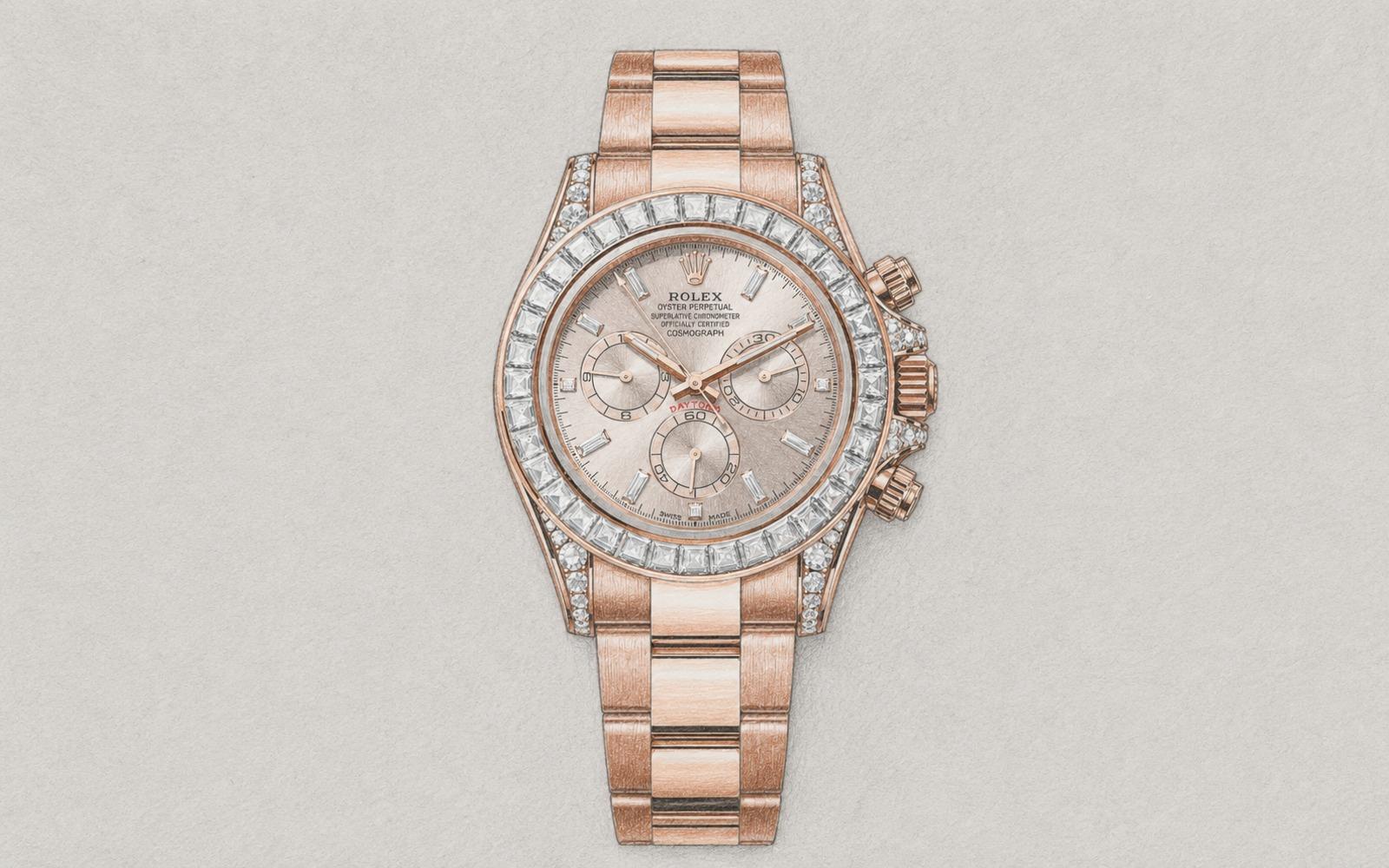
Ref: 126595TBR-0001
Diamond-set Everose Gold Sundust Diamond-Dial
0 Available
Today’s Market Value
$177,197
(MSRP $160,900)
Editorial Article
The Everose-gold Cosmograph Daytona is not a single watch so much as a family of personalities built around the same warm metal. At its core, the current collection divides between the reference 126505, with an Everose-gold tachymetric bezel and matching Oyster bracelet, and the reference 126515LN, which adds a black Cerachrom bezel and Rolex’s technical Oysterflex bracelet. Factory gem-set references extend those ideas even further, pairing diamond-set bezels and lugs with either a full Everose Oyster bracelet or Oysterflex. Together, they show how far the Daytona can travel—from substantial traditional chronograph to contemporary luxury sports watch to outright high jewelry—without surrendering its unmistakable three-counter identity. That identity began in 1963, when Rolex introduced the Cosmograph Daytona for professional racing drivers. Moving the tachymetric scale onto the bezel allowed average speed to be calculated over a measured distance while leaving the dial organized around elapsed hours, minutes and seconds. The earliest Daytonas were manually wound, relatively compact and conceived as working instruments rather than status objects. Their connection to Daytona International Speedway, later reinforced by Rolex’s wider relationship with endurance racing, gave the model an authentic motorsport foundation. Paul Newman supplied the cultural mythology, but the watch’s lasting importance came from Rolex’s ability to preserve its functional silhouette while repeatedly modernizing what lay beneath it. The Daytona became self-winding in 1988 with the Zenith-derived calibre 4030 generation and received Rolex’s fully manufacture-developed calibre 4130 in 2000. Everose gold arrived as a Rolex material in 2005, created to maintain the distinctive color of pink gold more consistently over time. The alloy contains at least 75 percent gold and 20 percent copper, with palladium and indium contributing to its color and stability. In 2008, reference 116505 brought Everose to a full-bracelet Daytona, establishing the formula that continues in the 126505: a 40 mm chronograph surrounded almost completely by softly reddish precious metal. A second Everose personality emerged with the reference 116515LN in 2011. Its black ceramic bezel was a major departure from the engraved metal bezels traditionally associated with the Daytona and gave the rose-gold watch a sharper, more overtly sporting appearance. Early examples were supplied on leather, but in 2017 Rolex placed its gold Daytonas on Oysterflex, a patented bracelet containing flexible metal blades beneath high-performance elastomer. When the revised 1265xx generation arrived in 2023, the contrast between the two Everose branches became even clearer: the 126505 remained the substantial, full-metal expression, while the 126515LN became the lighter-looking, ceramic-bezel alternative. Color plays an unusually important role throughout the line. Sundust dials echo the warmth of the case without becoming monochromatic, while bright-black and chocolate executions create stronger separation between the time display and chronograph counters. Diamond-set variants shift the emphasis toward jewelry, yet carefully positioned luminous markers and familiar register proportions keep the dial recognizably Daytona. The meteorite-dial 126515LN offers the most dramatic natural surface in the regular Everose range, using the crystalline Widmanstätten pattern of extraterrestrial material against black counters, bezel and Oysterflex. No two such dials are visually identical, giving a famously standardized Rolex an element of natural unpredictability. The full-bracelet 126505 and Oysterflex 126515LN may share their case material and movement, but they behave like different watches. The engraved Everose bezel and matching bracelet of the 126505 create an uninterrupted flow of metal that feels traditional, heavy and unmistakably precious. Its tachymetric scale remains exposed to everyday scratches, although the resulting marks can give the watch a more personal surface over time. The 126515LN’s black Cerachrom bezel is much more resistant to scratching and supplies a crisp visual frame around the dial. Oysterflex also distributes the weight differently and offers approximately 15 mm of Glidelock adjustment, whereas the full Oyster bracelet uses the more compact 5 mm Easylink extension. At the outer edge of the family sit the gem-set references 126595TBR and 126535TBR. Both surround their Sundust dials with diamond-set lugs and bezels containing 36 trapeze-cut diamonds, but one continues onto a full Everose Oyster bracelet while the other uses Oysterflex and contrasting black counter rings. These watches expose the most fascinating contradiction in the Everose Daytona line: replacing the tachymetric bezel with diamonds removes the scale that originally defined the watch as a tool for calculating speed. The chronograph remains mechanically functional, but its racing instrument has become a jewel. Rather than weakening the Daytona’s identity, that transformation demonstrates how recognizable its case, pushers and three-register dial have become even without the famous bezel markings. Every current Everose Daytona is powered by calibre 4131, introduced in 2023 with a column wheel, vertical clutch, Chronergy escapement, blue Parachrom hairspring and Paraflex shock absorbers. It supplies approximately 72 hours of power reserve and is regulated to Rolex’s Superlative Chronometer standard after casing. The Oyster case remains water-resistant to 100 meters, although the screw-down chronograph pushers must be released before timing can begin—a traditional Daytona quirk that favors security over instant operation. The family’s collectability is supported not by one dial or nickname, but by the breadth of its character: warm metal, serious chronograph engineering, historically faithful full-gold versions, technical Oysterflex models and gem-set interpretations that test the limits of what a racing watch can become. For a collection, an Everose Daytona offers something yellow and white gold cannot quite duplicate: obvious luxury softened by a richer, more nuanced color, wrapped around one of modern horology’s most enduring mechanical designs.
Market Dynamics
Scores from TimeAuthentic's latest AI market valuation of this reference.
Market data is compiled using AI-assisted research and extraction, and may contain inaccuracies.
Technical Data
Case
Shape
Round
Material
Diamond-set 18kt Everose gold case
Glass
Scratch-resistant sapphire crystal
Bezel
Diamond-set 18k Everose gold bezel
Case Back
Solid screw-down Everose gold case back
Dimension
40mm
Lug Distance
20mm
Lug-to-lug
47mm
Thickness
11.9mm
Water Resistance
100m / 10bar / 330ft
Case Specificities
Monobloc middle case; Triplock screw-down crown
Weight
214g
Dial & Hands
Dial Color
Diamond-set sundust dial
Hour Markers
Diamond-set hour markers
Hands
Gold baton hands, Chromalight lume
Specificities
Spray-coated counters, blue Chromalight display
Movement & Functions
Movement Type
Self-winding mechanical chronograph
Functions
Hours, minutes, small seconds, chronograph, stop-seconds
Caliber
Rolex 4131
Movement Description
Column wheel, vertical clutch, Chronergy escapement, 72-hour reserve
Strap
Material
Oyster three-piece solid 18kt Everose gold bracelet
Buckle
Everose gold folding Oysterlock, 5mm Easylink
Authentication Guide
Every TimeAuthentic marketplace transaction is designed to route through verification before final release. The watch is reviewed against the exact reference configuration, photographed, documented, and tied to its transaction record so buyers and sellers move through a consistent, trust-forward process.
Watch Passport
The TimeAuthentic Watch Passport is the identity layer attached to qualifying watches that move through authentication, service, vaulting, or purchase flows within the platform. It is designed to connect the watch, its documented handling history, and its supporting evidence into one consistent ownership record.