Calibrating your experience
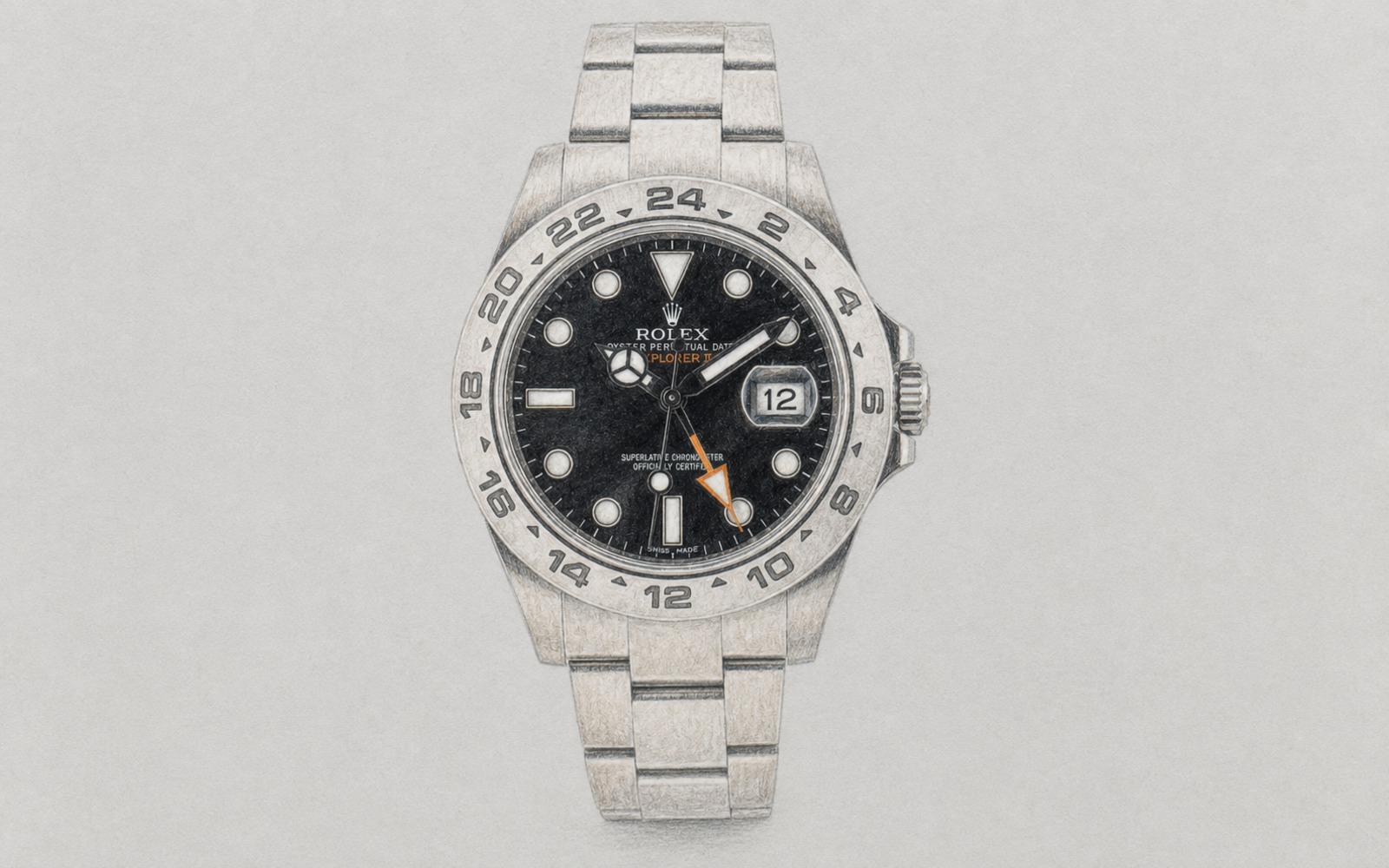
Rolex · Explorer II · Orange-Hand Gen (2011-2021)
Explorer II
Ref: 216570-0002
Black Dial
Also known as “Explorer II Polar”, “Polar Dial Explorer II”
0 Available
Today’s Market Value
$10,120
(MSRP $8,350)
Editorial Article
The Rolex Explorer II has always been the Rolex for people who like their adventure with a little more grit. It is not the shiniest Rolex, not the dressiest, not the most obvious status symbol, and that is exactly why so many collectors love it. The Explorer II is the watch for caves, glaciers, mountain passes, long flights, dark winters, and people who would rather be somewhere difficult than somewhere predictable. It is one of Rolex’s great tool watches, but it has always carried a slightly different personality from the Submariner, GMT-Master, or Daytona. It is rugged, practical, a little quirky, and quietly cool in a way that has only become more appreciated over time. The Explorer II was introduced in 1971 with the reference 1655, a watch built for people operating in environments where the normal rhythm of day and night could disappear. Cave explorers, polar travelers, volcanologists, and other extreme-environment specialists needed more than a standard time display. They needed a way to know whether it was morning or evening when the outside world was nowhere to be seen. Rolex answered with a fixed 24-hour bezel and a large additional 24-hour hand, giving the wearer a clear day-night reference in places where the sun could not help. That original Explorer II was not immediately beloved in the way some Rolex legends are today. It was unusual. The dial was busy, the orange 24-hour hand was bold, and the watch looked more technical than glamorous. But that strangeness is now a big part of its charm. The first Explorer II feels like a product of the 1970s in the best way: purposeful, graphic, experimental, and a little rebellious. It showed that Rolex could build a professional watch that was not simply another diver or pilot’s watch. This was a watch for the underground, the frozen edge of the map, and the places where time itself could feel distorted. As the line evolved, the Explorer II became easier to wear while keeping its original spirit. Later generations introduced a more familiar Rolex case shape, sapphire crystal, independently adjustable local hour hands, cleaner dials, and eventually larger 42mm proportions. The watch became more versatile, but it never lost the core idea: a tough steel Rolex with a fixed 24-hour bezel, a second time-zone or day-night display, and a personality rooted in exploration rather than luxury theater. One of the reasons the Explorer II has such a devoted following is that it feels like an insider’s Rolex. A Submariner announces itself instantly. A Daytona carries myth and market gravity everywhere it goes. A GMT-Master II has color, travel glamour, and bezel nicknames for days. The Explorer II is different. It is famous, but not flashy. Recognizable, but not obvious to everyone in the room. It is the kind of watch that often appeals to people who already know watches, already understand Rolex, and want something with real purpose but a little less herd behavior. The white “Polar” dial is one of the great reasons the Explorer II stands apart. Rolex sports watches are often black-dial dominant, but the Polar Explorer II gives the model a crisp, arctic personality that feels completely its own. The white dial makes the watch read brighter, cleaner, and more adventurous, almost like a piece of expedition equipment. It also gives the Explorer II a visual identity that no Submariner or GMT can quite duplicate. A Polar Explorer II does not feel like a white version of another Rolex. It feels like its own animal. Among collectors, the Polar dial has become especially loved because of the way certain older examples age. The most famous are the cream-dial Explorer II references, especially the transitional 16550, where some white dials developed a warm ivory or cream tone over time. What began as an unintended aging quirk became one of the most desirable traits in vintage and neo-vintage Explorer II collecting. The right cream Polar dial can completely transform the watch, giving it warmth, rarity, and a kind of naturally earned character that modern watches cannot simply manufacture. Even later Polar examples, especially tritium-era watches, can develop beautiful patina in the lume plots and hands. That soft aging against the white dial gives the Explorer II a very different emotional feel from a glossy modern Rolex. It becomes less clinical and more alive. Collectors love those details because they make each watch feel individual. Two Explorer IIs with the same reference number can tell very different stories depending on dial tone, lume color, case condition, bracelet stretch, service history, and originality. That is also why great Polar examples can fetch serious money. The Explorer II was once one of the more overlooked Rolex sports models, but the market has increasingly recognized how special the line is. Clean examples, full sets, late-production references, rare movement variants, sharp cases, and especially attractive Polar dials can all command meaningful premiums. Cream-dial pieces sit in an even more specialized category, where rarity, condition, and authenticity matter enormously. When the patina is right, the watch stops being merely an Explorer II and becomes a collector object. The black-dial Explorer II deserves love too. It is more understated, more tactical, and often a little more tool-like. On some references, the black dial gives the orange 24-hour hand extra punch; on others, it makes the watch feel more restrained and practical. If the Polar is the glacier, the black dial is the cave. One is bright, crisp, and expedition-ready; the other is darker, tougher, and more discreet. Together, they give the Explorer II line a simple but satisfying split personality. Modern Explorer II references continue the story with real confidence. The current generation keeps the 42mm case, the fixed steel 24-hour bezel, the orange 24-hour hand, the Oyster bracelet, and the core professional identity of the line. It is more refined than the early watches, of course, but it still feels like an Explorer II. It has not been softened into a dress watch or over-decorated into a jewelry piece. It remains a steel Rolex made for use, legibility, travel, and adventure. That is why the Explorer II remains one of the most interesting and popular Rolex models. It has history without feeling overexposed, utility without looking boring, and collector appeal without needing to shout. It is a watch with a job, a story, and a very specific kind of romance. Whether in black dial, modern Polar white, vintage tritium, or creamy aged glory, the Rolex Explorer II is the Rolex for people who like the road less traveled — and maybe the cave, mountain, glacier, or red-eye flight that comes with it.
Market Dynamics
Scores from TimeAuthentic's latest AI market valuation of this reference.
Market data is compiled using AI-assisted research and extraction, and may contain inaccuracies.
Technical Data
Case
Shape
Round
Material
Oystersteel
Glass
Sapphire crystal with date cyclops
Bezel
Fixed steel bezel
Case Back
Solid screw-down case back
Dimension
42mm
Lug Distance
21mm
Lug-to-lug
50mm
Thickness
12.5mm
Water Resistance
100M
Case Specificities
Luminous hands, Luminous indices, Central seconds, Screw-down crown, Chronometer, Other
Weight
156g
Dial & Hands
Dial Color
Black
Hour Markers
No numerals
Hands
Mercedes hour hand, orange 24h hand
Movement & Functions
Movement Type
Automatic
Functions
Date, GMT
Caliber
3187
Movement Description
48 hours power reserve · 28800 bph · 31 jewels
Strap
Material
Steel Oyster bracelet
Buckle
Dual folding clasp
Authentication Guide
Every TimeAuthentic marketplace transaction is designed to route through verification before final release. The watch is reviewed against the exact reference configuration, photographed, documented, and tied to its transaction record so buyers and sellers move through a consistent, trust-forward process.
Watch Passport
The TimeAuthentic Watch Passport is the identity layer attached to qualifying watches that move through authentication, service, vaulting, or purchase flows within the platform. It is designed to connect the watch, its documented handling history, and its supporting evidence into one consistent ownership record.