Calibrating your experience
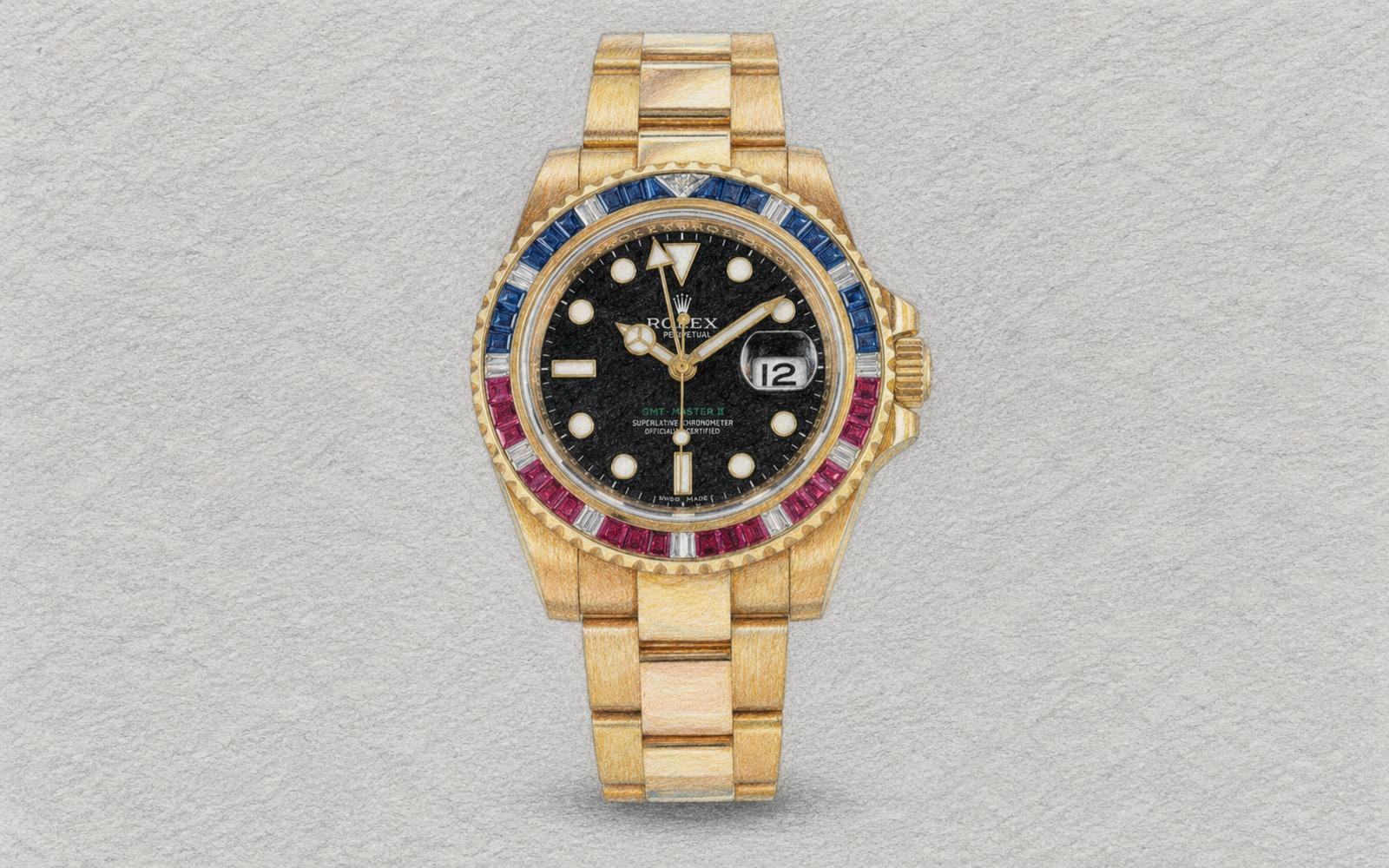
Rolex · GMT-Master II · 2005-2019 · Gem-Set Bezels
GMT-Master II
Ref: 116748SARU
18kt Yellow Gold, Diamond, Ruby and Sapphire-Set Bezel
Also known as “Pepsi”, “Gem-Set Pepsi”, “Pebble-Pepsi”
0 Available
Today’s Market Value
$89,742
Editorial Article
Any of the gem-set GMT-Masters are quite a spectacle to behold. But beyond this, there is a deep history to which they're a part of. The GMT-Master began life as one of Rolex’s purest instruments. Created in the 1950s for the new age of intercontinental flight, it allowed pilots and travelers to read two time zones at once by combining a conventional twelve-hour display with a fourth hand and a rotating 24-hour bezel. The idea was practical, almost austere, yet the watch quickly became one of Rolex’s most recognizable designs. The GMT-Master II, introduced in the early 1980s, made the concept more useful still by allowing the local hour hand to be adjusted independently. By the time Rolex began thoroughly modernizing the collection in the mid-2000s, the GMT had already spent half a century proving that a complicated function could be intuitive enough for daily wear. The six-digit generation transformed that familiar formula. Cases became visually broader and more substantial, crowns and crown guards gained presence, bracelets and clasps became considerably more robust, and the new architecture felt unmistakably contemporary even though the nominal case diameter remained 40 millimeters. Inside, calibre 3186 preserved the independently adjustable local hour while introducing refinements associated with Rolex’s modern movement technology, including the Parachrom hairspring. Ceramic Cerachrom bezel inserts appeared on mainstream models, bringing far greater resistance to scratching and fading. Yet alongside those technically minded watches, Rolex pursued an entirely different interpretation of the GMT concept: bezels in which the familiar 24-hour scale was rendered not in printed ceramic or aluminum, but through carefully selected precious stones. That idea had deeper roots than it first appears. Rolex had already experimented with gem-set GMT-Masters decades earlier, most famously with the yellow-gold 16758 SARU introduced at the end of the 1970s. Rubies and sapphires recreated the visual language of the red-and-blue GMT bezel while turning a professional travel watch into something closer to high jewelry. It was an audacious combination at the time, and the six-digit generation revived the concept with far greater technical sophistication. Yellow- and white-gold GMT-Master IIs appeared with bezels set in combinations of diamonds, blue sapphires, black sapphires and rubies, while some configurations extended the stone setting across the lugs, dial or bracelet. The result was not simply a jeweled version of a sports watch; it was a continuation of a strange but distinctly Rolex tradition. Among the most memorable are the SARU references, whose red rubies and blue sapphires reinterpret the classic “Pepsi” color scheme in gemstones. The effect is clever because it preserves one of the GMT-Master’s most important visual cues while completely changing its character. Other versions used blue sapphires with diamonds or black sapphires with diamonds, creating cooler, more monochromatic variations that could appear almost restrained from a distance despite the extraordinary material involved. Yellow gold amplified the spectacle, while white gold allowed the stones themselves to dominate. Black lacquer dials kept some examples visually grounded in the conventional GMT-Master II family, while diamond-set dials and bracelets pushed others much further into jewelry territory. The underlying watch remained recognizably a GMT, but almost every surface surrounding its mechanics could be reinterpreted. That tension between utility and ornament is what makes these watches historically interesting. Rolex did not begin with a jewelry watch and add a second time-zone complication; it began with one of its most famous professional instruments and deliberately dressed it in precious stones. The rotating bezel remained part of the architecture, and the independent local-hour system still worked exactly as it did in the more familiar steel models. Yet the bezel’s traditional numerals were replaced by arrangements of colored stones and diamonds, sacrificing some immediate functional clarity in exchange for an entirely different visual language. It is one of the rare occasions in Rolex history where practical design was knowingly allowed to share the stage with extravagance rather than dominate it. The extreme expression of that philosophy was the white-gold reference 116769TBR, commonly known as the “Ice.” Introduced during this generation, it covered almost every visible surface in diamonds, including the case, dial, bezel and bracelet. Baguette-cut stones formed the bezel and bracelet center links, while pavé diamonds occupied areas that would ordinarily be brushed or polished metal. Despite that transformation, underneath remained a functioning GMT-Master II powered by calibre 3186, complete with its independently adjustable hour hand and 100-meter water resistance. The absurdity is part of its importance: Rolex took a watch descended from airline navigation equipment and used it as a demonstration of serious gem-setting capability. Few watches illustrate the brand’s ability to inhabit the worlds of tool watch and high jewelry at the same time quite so dramatically. Collectors are drawn to these pieces for reasons that go beyond simple rarity. Factory gem-setting is fundamentally different from later customization, and provenance matters enormously. The stone selection, cutting, matching, setting patterns and case preparation were all conceived as part of the watch from the beginning. Correct factory dials, bracelets, bezels and case configurations therefore become essential to understanding an individual example. The variety within the family adds another layer of interest: some watches retain relatively conventional black dials and polished bracelets, while others use pavé dials, diamond-set links or heavily jeweled cases. Two watches sharing the same basic GMT architecture can consequently feel radically different on the wrist, making the gem-set branch unusually rich for collectors who enjoy studying small production variations. There are practical quirks. Precious-metal cases and bracelets make these watches considerably heavier than their steel relatives, and elaborate gem setting demands greater care during servicing, refinishing and restoration. Stones and settings should be examined closely, particularly because replacing missing or damaged factory components can be far more complicated than sourcing ordinary GMT parts. Their visual intensity also means they are not remotely discreet watches, even by modern luxury-sports standards. Yet mechanically they retain the straightforward usability that made the GMT-Master II successful in the first place. The jumping local-hour hand, date display, automatic movement and robust Oyster architecture remain easy to live with, creating an unusual combination of functional competence and theatrical presentation. Within Rolex history, these GMT-Master IIs occupy a fascinating position. The broader six-digit generation marked the point at which the brand decisively modernized one of its most important sports watches, introducing new materials, heavier construction and a more luxurious finish that would shape subsequent GMT-Master IIs. The gem-set versions reveal another side of that transition: Rolex was not merely making its professional watches tougher and more contemporary, but also exploring how far their identities could be stretched without becoming unrecognizable. For a collection, they offer something the conventional steel models cannot—a direct link between the GMT’s utilitarian aviation heritage and Rolex’s long, sometimes surprising mastery of jewelry watchmaking. They are extravagant, occasionally impractical and impossible to mistake for anything else, which is precisely why they deserve a serious place in the story of the GMT-Master II.
Market Dynamics
Scores from TimeAuthentic's latest AI market valuation of this reference.
Market data is compiled using AI-assisted research and extraction, and may contain inaccuracies.
Technical Data
Case
Shape
Round
Material
18k yellow-gold case and bracelet
Glass
Sapphire crystal with Cyclops
Bezel
Yellow gold, bidirectional; baguette diamonds, rubies and sapphires
Case Back
Solid, screw-down yellow gold
Dimension
40mm
Lug Distance
20mm
Lug-to-lug
47.5mm
Thickness
12mm
Water Resistance
100m / 10bar / 330ft
Case Specificities
Triplock crown; crown guards; gem-set bezel
Weight
220g
Dial & Hands
Dial Color
Black
Hour Markers
Gold-tone luminous index markers
Hands
Gold-tone Mercedes; luminous; arrow GMT hand
Specificities
Date magnifier; independent local-hour adjustment
Movement & Functions
Movement Type
Mechanical automatic
Functions
Hours, minutes, seconds, date, second time zone
Caliber
3186
Movement Description
31 jewels; 28,800 vph; approximately 48-hour reserve
Strap
Material
18k yellow-gold Oyster bracelet
Buckle
Yellow-gold Oysterlock folding clasp
Authentication Guide
Every TimeAuthentic marketplace transaction is designed to route through verification before final release. The watch is reviewed against the exact reference configuration, photographed, documented, and tied to its transaction record so buyers and sellers move through a consistent, trust-forward process.
Watch Passport
The TimeAuthentic Watch Passport is the identity layer attached to qualifying watches that move through authentication, service, vaulting, or purchase flows within the platform. It is designed to connect the watch, its documented handling history, and its supporting evidence into one consistent ownership record.