Calibrating your experience
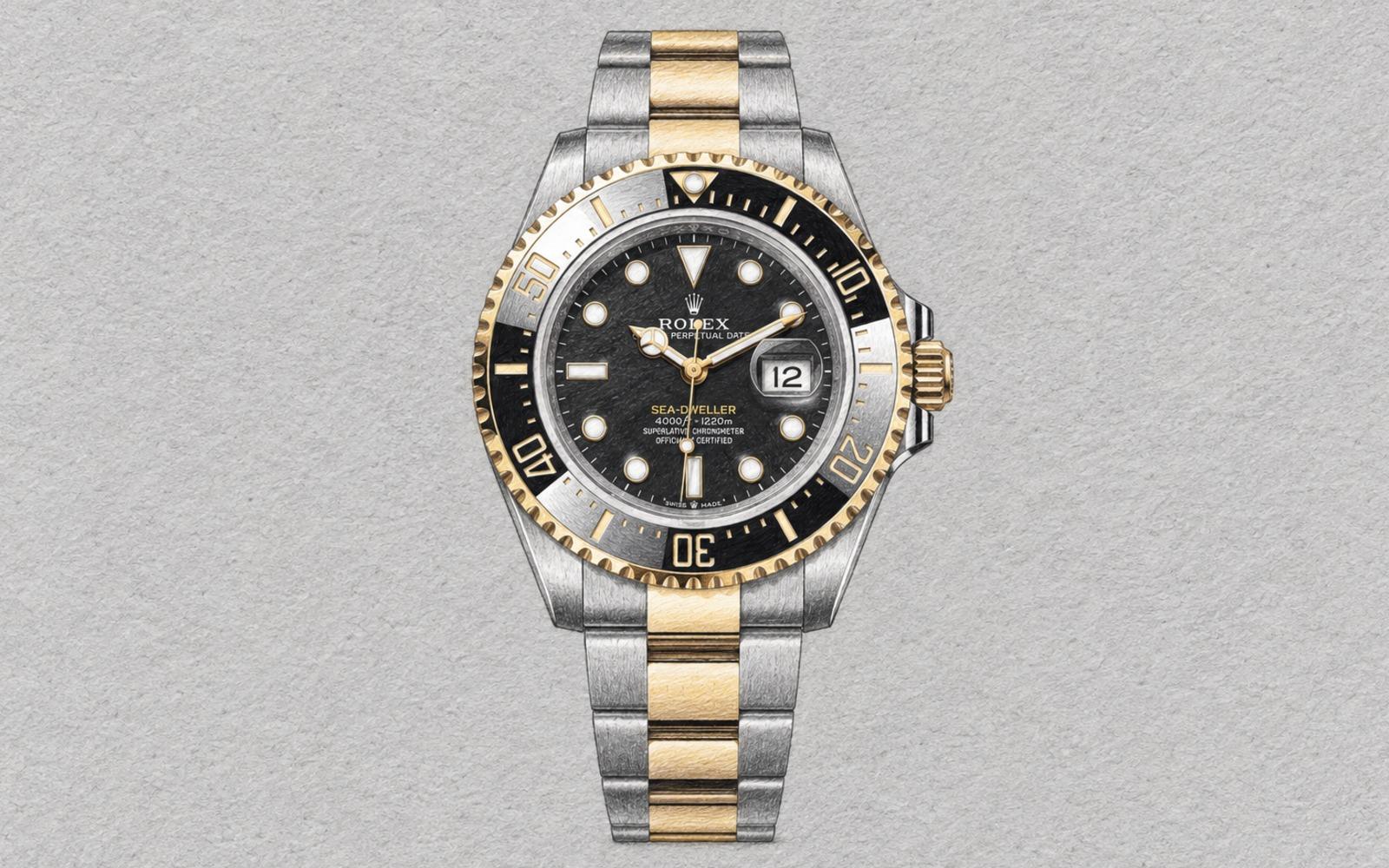
Rolex · Sea-Dweller · Oystersteel (Copy)
Sea-Dweller
Ref: 126603-0001
Yellow Rolesor
0 Available
Today’s Market Value
$17,285
(MSRP $22,450)
Editorial Article
The Sea-Dweller exists because ordinary dive watches encountered a very specific problem once humans began living and working underwater for extended periods. During saturation diving, helium from the divers’ breathing mixture could slowly enter a watch case; during decompression, the trapped gas sometimes expanded faster than it could escape, with enough pressure to force the crystal from the watch. Rolex responded with a purpose-built solution and launched the Sea-Dweller in 1967, pairing exceptional water resistance with a patented helium escape valve. The original watch was rated to 610 metres, or 2,000 feet, and its development was closely tied to the emerging world of professional saturation diving rather than simply recreational scuba. That professional heritage quickly became inseparable from the model’s identity. Sea-Dwellers were used during underwater-habitat experiments such as Tektite and became associated with the French commercial-diving specialist COMEX, whose demanding work provided an unusually serious proving ground for Rolex dive watches. By 1978 the Sea-Dweller’s water-resistance rating had doubled to 1,220 metres, or 4,000 feet, establishing the figure that remains attached to the standard Sea-Dweller today. Through references such as the early 1665, the later 16660 and the long-running 16600, the model developed into the more specialized, less common sibling of the Submariner: visually familiar, but engineered around a much more extreme use case. The lineage was not completely continuous. After the reference 16600 disappeared in 2008, Rolex pushed its deep-diving ambitions toward the much larger Deepsea, before bringing the traditional Sea-Dweller format back in 2014 with the 40 mm reference 116600. That revival proved brief but important. In 2017, for the Sea-Dweller’s 50th anniversary, Rolex substantially reworked the watch into the reference 126600, increasing the case from 40 to 43 mm, introducing calibre 3235 and placing the model name in red on the dial as a deliberate nod to the earliest examples. It was less a nostalgic recreation than a modern reinterpretation of what the Sea-Dweller should be. The resulting watch occupies a useful middle ground within Rolex’s diving family. Its 43 mm case gives it substantially more wrist presence than a Submariner without approaching the sheer bulk of the Deepsea, while its 1,220-metre rating and automatic helium escape valve preserve the specialized engineering that has always distinguished the model. A black Cerachrom bezel, highly legible Chromalight display, Triplock crown and Glidelock-equipped Oyster bracelet make it thoroughly contemporary, and calibre 3235 provides approximately 70 hours of power reserve along with Rolex’s modern movement architecture. It remains an unapologetically serious dive watch even though almost none of its owners will ever subject it to conditions remotely close to those it was designed to survive. Perhaps the most controversial change was also one of the smallest: the Cyclops magnifier above the date. Earlier Sea-Dwellers had traditionally displayed their date through an unmagnified crystal, a detail that helped distinguish them from the Submariner Date. Rolex added the Cyclops in 2017, making the date easier to read but removing a visual characteristic that many enthusiasts considered fundamental to the model. The larger case attracted similar debate. For some collectors, 43 mm gave the Sea-Dweller the visual and physical separation from the Submariner that it had long needed; for others, it sacrificed some of the compact tool-watch charm of earlier generations. Those arguments have become part of the watch’s character rather than diminishing it. Then Rolex did something even less expected. In 2019 it introduced reference 126603, the first Sea-Dweller to combine Oystersteel with 18-karat yellow gold. The yellow Rolesor version retained the same 43 mm dimensions, water resistance, helium escape valve and calibre 3235, but added gold to the bracelet centre links, crown, bezel markings, hands and hour markers. For a watch born from commercial saturation diving, gold might seem almost mischievously inappropriate—and that is precisely what makes the configuration interesting. It demonstrates how far the Sea-Dweller has travelled from being specialist equipment without erasing the engineering underneath. The steel reference remains the more traditional expression, while the Rolesor model introduces a distinctly Rolex mixture of luxury and extreme capability. Collectors are drawn to the Sea-Dweller partly because its history is unusually tangible. The helium escape valve was not invented to create another line on a specification sheet; it addressed a real problem encountered by saturation divers. Early red-text dials, COMEX associations and successive increases in depth capability give vintage Sea-Dwellers considerable historical depth, while the present generation carries those visual and mechanical ideas forward without pretending to be vintage. The single line of red “Sea-Dweller” text is especially effective in this respect. It is a tiny detail, but anyone familiar with the model’s history immediately understands why it is there. As a collection piece, the modern Sea-Dweller makes the most sense for someone who wants a Rolex diver that feels meaningfully different from the more familiar Submariner. It is larger, heavier and less universally wearable, and the 43 mm case can be demanding on smaller wrists. The Cyclops will never satisfy every Sea-Dweller traditionalist, while the Rolesor version deliberately challenges the model’s old image of pure utilitarianism. Yet those quirks are also what prevent it from becoming merely an enlarged Submariner. The Sea-Dweller remains one of the clearest examples of Rolex engineering being shaped by an actual professional problem, and the current watches preserve that lineage in a package that is robust enough for saturation diving, refined enough for everyday wear and distinctive enough to hold its own in a collection full of better-known Rolex icons.
Market Dynamics
Scores from TimeAuthentic's latest AI market valuation of this reference.
Market data is compiled using AI-assisted research and extraction, and may contain inaccuracies.
Technical Data
Case
Shape
Round
Material
Oystersteel monobloc middle case
Glass
Scratch-resistant sapphire with Cyclops lens
Bezel
18kt Yellow gold unidirectional 60-minute black Cerachrom bezel, platinum graduations
Case Back
Screw-down solid Oystersteel case back
Dimension
43mm
Lug Distance
22mm
Lug-to-lug
50.4mm
Thickness
15.2mm
Water Resistance
1,220m / 122bar / 4,000ft
Case Specificities
Triplock crown, helium escape valve, Oyster architecture
Weight
216g
Dial & Hands
Dial Color
Intense black
Hour Markers
Applied white-gold markers with blue Chromalight lume
Hands
Professional Mercedes-style hands with blue Chromalight lume
Specificities
Red Sea-Dweller text; date display with Cyclops lens
Movement & Functions
Movement Type
Mechanical automatic
Functions
Hours, minutes, seconds, date, stop-seconds
Caliber
Rolex 3235
Movement Description
Perpetual self-winding movement, Chronergy escapement, 70-hour reserve
Strap
Material
Oyster three-piece solid-link Yellow Rolesor bracelet
Buckle
Folding Oysterlock safety clasp with Glidelock extension
Authentication Guide
Every TimeAuthentic marketplace transaction is designed to route through verification before final release. The watch is reviewed against the exact reference configuration, photographed, documented, and tied to its transaction record so buyers and sellers move through a consistent, trust-forward process.
Watch Passport
The TimeAuthentic Watch Passport is the identity layer attached to qualifying watches that move through authentication, service, vaulting, or purchase flows within the platform. It is designed to connect the watch, its documented handling history, and its supporting evidence into one consistent ownership record.