Calibrating your experience
Rolex · Yacht-Master II · 2026-Current Generation · Oystersteel
Yacht-Master II
Ref: 126680-0001
Oystersteel
0 Available
Today’s Market Value
$26,553
(MSRP $20,300)
Editorial Article
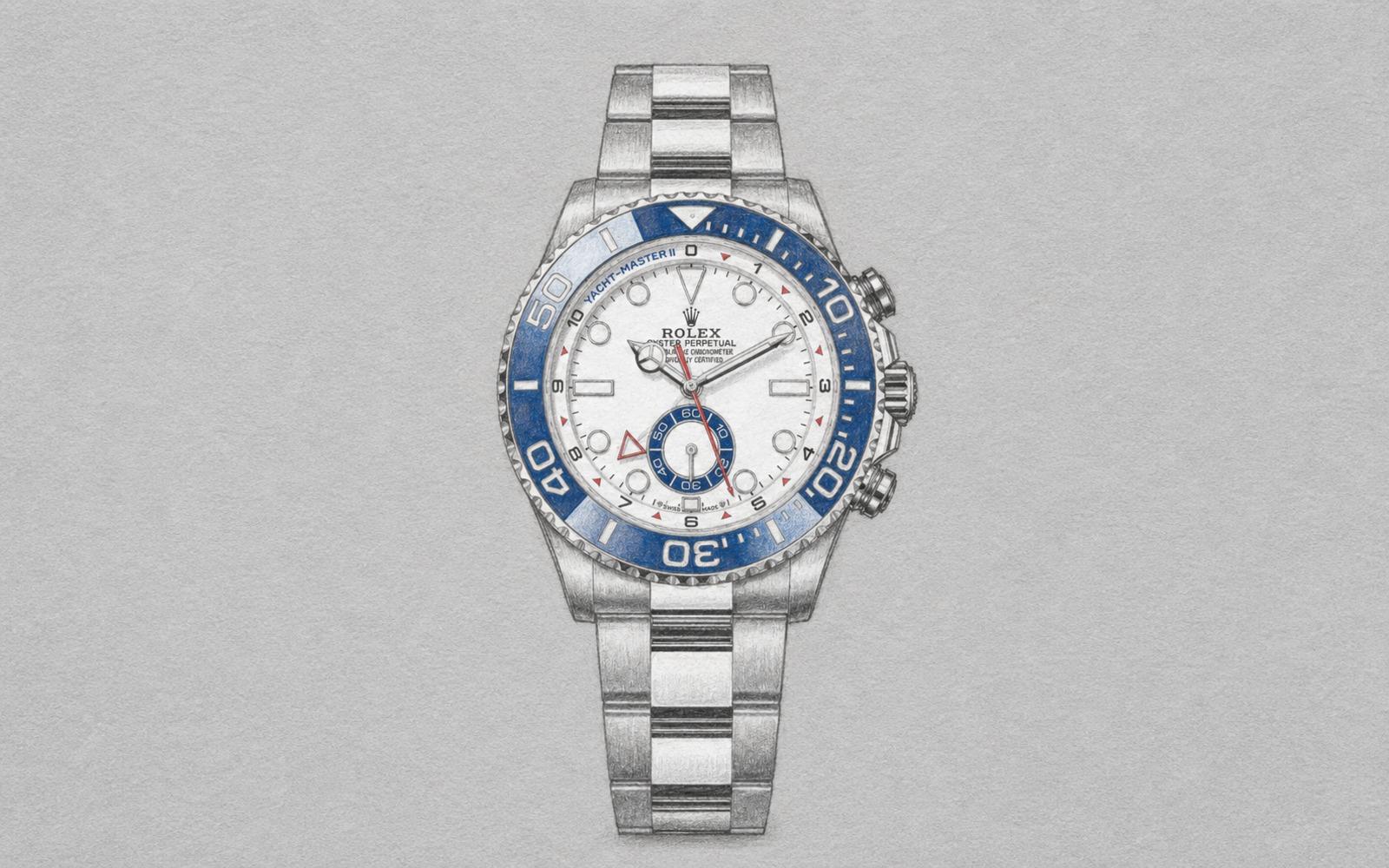
The Yacht-Master II shares a name and nautical theme with the Yacht-Master introduced in 1992, but the resemblance has always been more familial than functional. When Rolex presented the Yacht-Master II in 2007, it was not simply a larger, more complicated version of the existing watch. It was a purpose-built regatta chronograph created around one highly specialized task: counting down the minutes before the start of a sailing race. Rolex described it as the first wristwatch equipped with a programmable countdown incorporating a mechanical memory, immediately placing it among the company’s most technically ambitious modern creations. That unusual function makes sense once the controlled chaos of a regatta start is understood. Racing yachts cannot wait motionless on a painted line, so crews maneuver at speed while official signals count down the remaining minutes. The original Yacht-Master II allowed its wearer to program a period from one to ten minutes, start the countdown, correct it to match an official signal and then reuse the memorized setting. It was a wonderfully specific solution to a real sporting problem. The first generation’s mechanical centerpiece was its Ring Command system. Turning the bezel placed the movement into programming mode, the crown selected the countdown duration, and returning the bezel to its starting position locked that choice into the watch’s mechanical memory. The chronograph pushers then started, stopped, reset and synchronized the display. Early watches used calibre 4160 before the family moved to calibre 4161, a self-winding column-wheel chronograph movement with a vertical clutch and approximately 72 hours of power reserve. The system was complex beneath the dial but deliberately logical at the fingertips—a very Rolex approach to complication building. Rolex offered the original model in a notably broad range of metals. The family included yellow gold, white gold with a solid platinum bezel, Everose Rolesor combining steel and rose gold, and eventually Oystersteel. All were imposing 44 mm watches with white dials, Oyster bracelets and unmistakable nautical colors. The large blue bezel insert—famously carrying the words “Yacht-Master II”—made the watch instantly recognizable from across a room. That extroverted appearance was part of its appeal, but it also ensured that the model would become one of the most debated designs in the Rolex catalog. A restrained 2017 revision addressed some of the first generation’s legibility concerns without changing its fundamental character. The earlier slim baton hands gave way to a familiar Mercedes-style hour hand and a partially skeletonized minute hand, while a triangular marker at 12 and a rectangular marker at 6 improved orientation. The changes added a little more conventional Rolex visual language to a watch that had previously looked unlike almost anything else from the brand. Collectors now have a clear choice between the cleaner, more unusual early dial and the more immediately readable later execution. Within Rolex history, the Yacht-Master II occupies an unusually independent position. It was neither an evolutionary diving watch nor another variation on the conventional chronograph. Its movement, display and controls existed for a single specialized purpose, and its Ring Command architecture later demonstrated how a bezel could become a true mechanical interface rather than merely a rotating scale. After a production run spanning four metal combinations and several subtle updates, the first-generation collection was discontinued in 2024. The resulting absence was brief but significant: for two years, one of Rolex’s boldest complications disappeared from the catalog entirely. The Yacht-Master II returned in 2026 as a thoroughly reworked watch rather than a nostalgic reissue. Initially offered in Oystersteel and yellow gold, references 126680 and 126688 retain the 44 mm case size but introduce calibre 4162, a redesigned countdown display and a more direct pusher-operated interface. The Ring Command programming system is gone; each press of the lower pusher adds a minute to the memorized countdown, while the upper pusher starts and stops it. Most strikingly, the countdown hands travel counterclockwise toward zero—a first for Rolex and an intuitive visual expression of time running out. A matte white dial, slimmer case profile, broader bracelet and winch-inspired pushers further distinguish the new generation. Collectors are drawn to the Yacht-Master II because it offers something increasingly valuable in a mature watch catalog: genuine individuality. Early baton-hand examples, later Mercedes-hand watches, the stealthier white-gold-and-platinum model, the flamboyant yellow-gold version and the accessible steel reference each express the same concept differently. The revived generation adds another dividing line, replacing the original’s mechanically theatrical bezel interface with a simpler and more readable system. Strong originality, complete accessories, correct dial-and-hand combinations and well-preserved cases are therefore especially meaningful when comparing examples from the first production era. Its defining strengths are also its unavoidable quirks. The Yacht-Master II is large, visually busy and far less versatile than a conventional elapsed-time chronograph. Its 100-metre water resistance is entirely practical, though modest beside Rolex’s professional diving watches, and its specialized countdown may have little everyday use away from competitive sailing. Yet those limitations are precisely what keep it interesting. The model represents Rolex at its most adventurous: technically serious, stylistically unapologetic and willing to devote immense mechanical effort to a very narrow problem. For a collection already populated by familiar divers, travel watches and traditional chronographs, the Yacht-Master II brings a welcome streak of eccentricity—and a complication that no other Rolex can quite imitate.
Market Dynamics
Scores from TimeAuthentic's latest AI market valuation of this reference.
Market data is compiled using AI-assisted research and extraction, and may contain inaccuracies.
Technical Data
Case
Shape
Round
Material
Oystersteel
Glass
Sapphire crystal; anti-reflective coating
Bezel
Bidirectional blue 60-minute Cerachrom bezel
Case Back
Solid screw-down Oystersteel case back
Dimension
44mm
Lug Distance
22mm
Lug-to-lug
50mm
Thickness
13.9mm
Water Resistance
100m / 10bar / 330ft.
Weight
190g
Dial & Hands
Dial Color
Matte white lacquer
Hour Markers
Applied white-gold Chromalight indexes
Hands
White-gold Chromalight; red countdown hands
Specificities
10-to-0 flange; counterclockwise countdown display
Movement & Functions
Movement Type
Automatic mechanical column-wheel chronograph
Functions
Time; small seconds; programmable synchronized countdown
Caliber
4162
Strap
Material
Oystersteel three-piece Oyster bracelet
Buckle
Oysterlock safety clasp; Easylink 5 mm
Authentication Guide
Every TimeAuthentic marketplace transaction is designed to route through verification before final release. The watch is reviewed against the exact reference configuration, photographed, documented, and tied to its transaction record so buyers and sellers move through a consistent, trust-forward process.
Watch Passport
The TimeAuthentic Watch Passport is the identity layer attached to qualifying watches that move through authentication, service, vaulting, or purchase flows within the platform. It is designed to connect the watch, its documented handling history, and its supporting evidence into one consistent ownership record.