Calibrating your experience
TUDOR · Black Bay · Black Bay · Red Bezel on 3-Link Bracelet (Copy)
Black Bay
Ref: M7941A1A0RU-0002
Red Bezel, Black Dial on 5-Link Bracelet
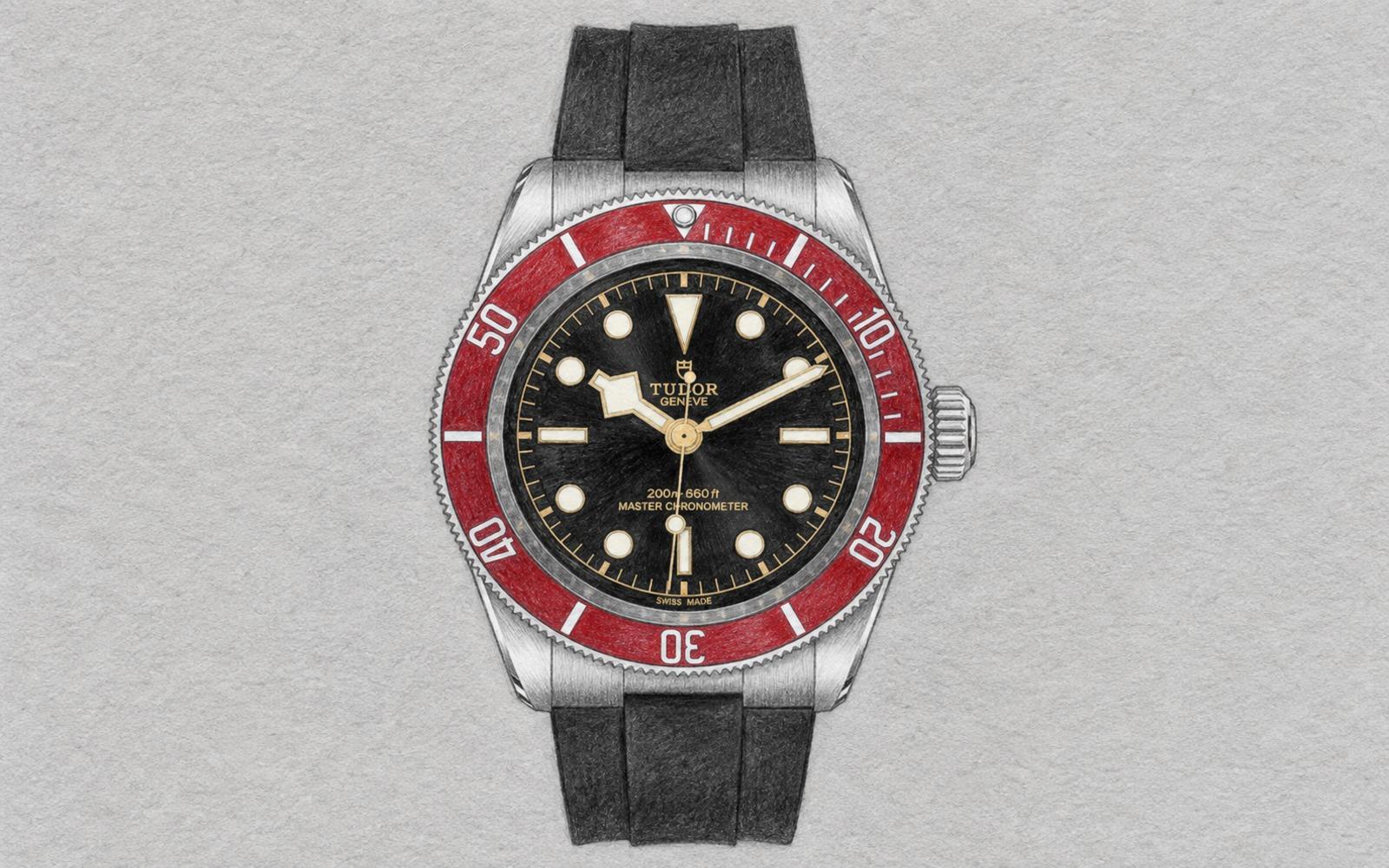
0 Available
Today’s Market Value
$3,494
(MSRP $5,075)
Editorial Article
The Black Bay began in 2012, but its story had already been underwater for nearly six decades. TUDOR entered the diving-watch business in 1954 with the Oyster Prince Submariner reference 7922, a straightforward professional instrument built around the same ideals that would repeatedly define the brand: toughness, legibility and serious capability without unnecessary ornament. The formula matured quickly. Reference 7924 of 1958 brought 200-meter water resistance and the oversized “Big Crown” that collectors now regard as one of TUDOR’s great historical signatures, while the succeeding 7928 added protective crown guards. These were not watches designed merely to look adventurous. TUDOR Submariners were evaluated and used by military organizations including the French and United States navies, giving the company a professional diving history with unusually tangible credentials. The other crucial ingredient arrived at the end of the 1960s. In 1969, TUDOR introduced a new generation of Submariners with square luminous hour markers and angular hands whose blocky tips allowed generous applications of luminous material. Collectors eventually christened them “Snowflake” hands, and what began as a functional solution became perhaps the single most recognizable visual element in modern TUDOR design. The Black Bay would later combine that 1969 hand shape with the domed surfaces, exposed crowns and other cues of earlier 1950s divers. That mixture is important: the Black Bay was never a reproduction of one historical TUDOR. It was a deliberately assembled vocabulary of the brand’s past, allowing TUDOR to revive its diving heritage without chaining itself to the dimensions or details of any single vintage reference. When the first Black Bay appeared in 2012, its burgundy bezel, gilt-toned details, large unguarded crown and domed profile were unmistakably nostalgic, but the watch did something more useful than imitate an old Submariner. It gave TUDOR a modern identity of its own. The initial generation used externally sourced movements, yet its personality was strong enough that the Black Bay quickly became central to TUDOR’s international resurgence. In 2016 the core model received TUDOR’s Manufacture Calibre treatment, turning what had begun largely as a compelling exercise in historical design into an increasingly serious platform for the company’s mechanical ambitions. The subsequent third evolution of the 41 mm Black Bay went further still, adopting METAS Master Chronometer certification and demonstrating how far the concept had moved from charming retro diver to technically sophisticated contemporary watch. Expansion could easily have diluted the idea, but instead it revealed how elastic the Black Bay design language was. The Black Bay 58 brought the proportions closer to the celebrated reference 7924 with a 39 mm case and became an enthusiast favorite in its own right; the Black Bay 54 went further, returning to the compact 37 mm scale and sparsely marked bezel of the original 7922. At the opposite end, the 43 mm Black Bay 68 deliberately rejects the industry’s relentless march toward smaller cases and ties its name to the period in which the Snowflake design was conceived. Materials became another playground: bronze develops an individual patina, sterling silver gives the 58 an unexpectedly soft visual character, yellow gold turns the old tool-watch formula on its head, and ceramic carries the design into distinctly modern territory. Rather than one Black Bay stretched into different sizes, the result is a family in which the same historical DNA can feel remarkably different depending on proportions, color and material. Then TUDOR began asking what else a Black Bay could do. The GMT added independently adjustable local time and a 24-hour rotating bezel, while the more compact Black Bay 58 GMT brought the travel complication into the 39 mm format with a dedicated integrated Manufacture Calibre and Master Chronometer certification. The Black Bay Pro takes an even more utilitarian approach, using a fixed 24-hour steel bezel and prominent yellow GMT hand to create something closer to an expedition instrument. The Black Bay Chrono goes in another direction altogether, combining the Snowflake vocabulary of TUDOR’s divers with the company’s separate chronograph history, which dates to 1970; its automatic calibre uses a column wheel and vertical clutch, the sort of architecture enthusiasts expect from a serious modern chronograph. What could have become a collection of unrelated spin-offs instead demonstrates how a strong visual identity can survive the addition of genuinely different functions. The family has also become a showcase for TUDOR’s technical growth. Manufacture movements with free-sprung balances, silicon hairsprings and long power reserves replaced the more conventional architecture of the earliest Black Bays, while the 2021 Black Bay Ceramic introduced METAS Master Chronometer certification to the collection. That standard tests the completed watch rather than merely the uncased movement and incorporates chronometric performance, water resistance, power reserve and resistance to magnetic fields reaching 15,000 gauss. METAS certification has since spread through important Black Bay references, including the current core Black Bay, newer Black Bay 58 models, the 58 GMT and Black Bay 68. The evolution is significant because TUDOR has managed to improve the engineering without abandoning the analog charm that attracted people to the Black Bay in the first place; underneath all the vintage-colored lume, aluminum bezels and domed crystals is an increasingly modern piece of watchmaking. Collectors respond to the Black Bay partly because its history is already layered enough to reward close attention. Early ETA-powered examples preserve the character of the line before the manufacture-movement transition; different crown signatures, dial treatments, bezels, bracelets and generations give specialists plenty to distinguish; and unusual materials such as bronze, silver, ceramic and gold create versions whose personalities extend beyond color changes. The Black Bay 58 has developed its own branches, the GMT and Chrono connect the design to other categories of watchmaking, and the Black Bay One carries the Snowflake language into a smoother, more polished and less overtly tool-oriented form in sizes from 31 to 41 mm. None of this requires artificial rarity to be interesting. The collecting appeal comes from recognizable evolutionary steps, genuine historical references and enough mechanical and aesthetic variation that several Black Bays can coexist in a collection without feeling like duplicates. Its limitations are largely the reverse side of its strengths. Some generations are thick, some historical references are worn rather visibly on their sleeves, aluminum bezels acquire marks that ceramic would shrug off, bronze changes color whether its owner wants it to or not, and the sheer number of Black Bay variants can make the family seem almost too successful for its own good. Yet its importance to contemporary horology is difficult to separate from precisely that success. The Black Bay helped demonstrate that a historically informed watch did not need to be an exact reissue, and that accessible luxury could combine serious movements, distinctive design and authentic archival material without pretending to be vintage. More than a decade after its arrival, it has grown from a single burgundy-bezel diver into the central language through which TUDOR expresses diving history, travel, chronographs, precious metals, modern materials and several generations of movement technology. For a collection, that makes the Black Bay compelling not simply as a good sports watch, but as a remarkably concise history of how TUDOR rediscovered its past and used it to build its modern identity.
Market Dynamics
Scores from TimeAuthentic's latest AI market valuation of this reference.
Market data is compiled using AI-assisted research and extraction, and may contain inaccuracies.
Technical Data
Case
Shape
Round
Material
Stainless Steel
Glass
Domed sapphire crystal
Bezel
60-minute unidirectional steel, burgundy aluminum
Case Back
Solid steel screw-down caseback
Dimension
41mm
Lug Distance
21mm
Lug-to-lug
49.2mm
Thickness
13.6mm
Water Resistance
200m / 20bar / 660ft
Case Specificities
Polished/satin finish; screw-down rose crown
Weight
114g
Dial & Hands
Dial Color
Black
Hour Markers
Gilt-framed luminous dots, batons, triangle
Hands
Gilt Snowflake hands with Super-LumiNova
Movement & Functions
Caliber
MT5602-U
Strap
Material
Black rubber strap
Buckle
TUDOR 'T-fit' folding clasp
General
Magnetic Resistant
15,000 gauss
Authentication Guide
Every TimeAuthentic marketplace transaction is designed to route through verification before final release. The watch is reviewed against the exact reference configuration, photographed, documented, and tied to its transaction record so buyers and sellers move through a consistent, trust-forward process.
Watch Passport
The TimeAuthentic Watch Passport is the identity layer attached to qualifying watches that move through authentication, service, vaulting, or purchase flows within the platform. It is designed to connect the watch, its documented handling history, and its supporting evidence into one consistent ownership record.